
Agency perspective
From WhatsApp chaos to a clearer working day
A conversation with Eduard WittnerVilla Noble
A closer look at a different way to work in Marbella: client requests, property matches and agency collaboration, all in one place.
The interview
Eduard Wittner in conversation
Eduard, what did a normal day look like before Liisto?
Groups. A dozen of them, all day. Listings, client requests, open houses, price changes. You would see something useful go past while you were driving to a viewing, and by the evening it was buried. The information was there, the access to it was the problem.
What was the most frustrating part of it?
The invisible match. You have a client looking for something very specific and somewhere in the network there is a property that fits it. But it is in a chat you are not in, or with an agency you have never spoken to, or three hundred messages up in a group you muted last month. You cannot sell what you cannot find.
How does Liisto change that?
It runs the comparison for us, in both directions. When I put a client request in, Liisto checks it against our own listings and against what other agencies have published. When we publish a listing, Liisto finds the client requests that fit it, including requests from other agents. The match comes to us with a score and the reasons, so I can see why it fits before I call the client.
And the agency side of it?
The whole team sits in one workspace. Everybody can see the same listings and the same client requests. A listing can be assigned to the agent who is actually handling it, so we know who is following up on what. Before, that lived in somebody’s head.
How do client requests get in?
As they arrive. If a client calls, we type it in. If the client sends it on WhatsApp, we paste the message and it becomes a structured request with the area, budget, bedrooms and the features that matter. That is what the matching works from, and it takes a minute instead of a form.
What happens when we list something and another agency has a matching client?
That is the direction most people forget. The agent with the client request is the one who gets told, and the request arrives attached to our listing. Nobody had to broadcast it into a group and hope the right person was reading.
What about the same property being listed by several agencies?
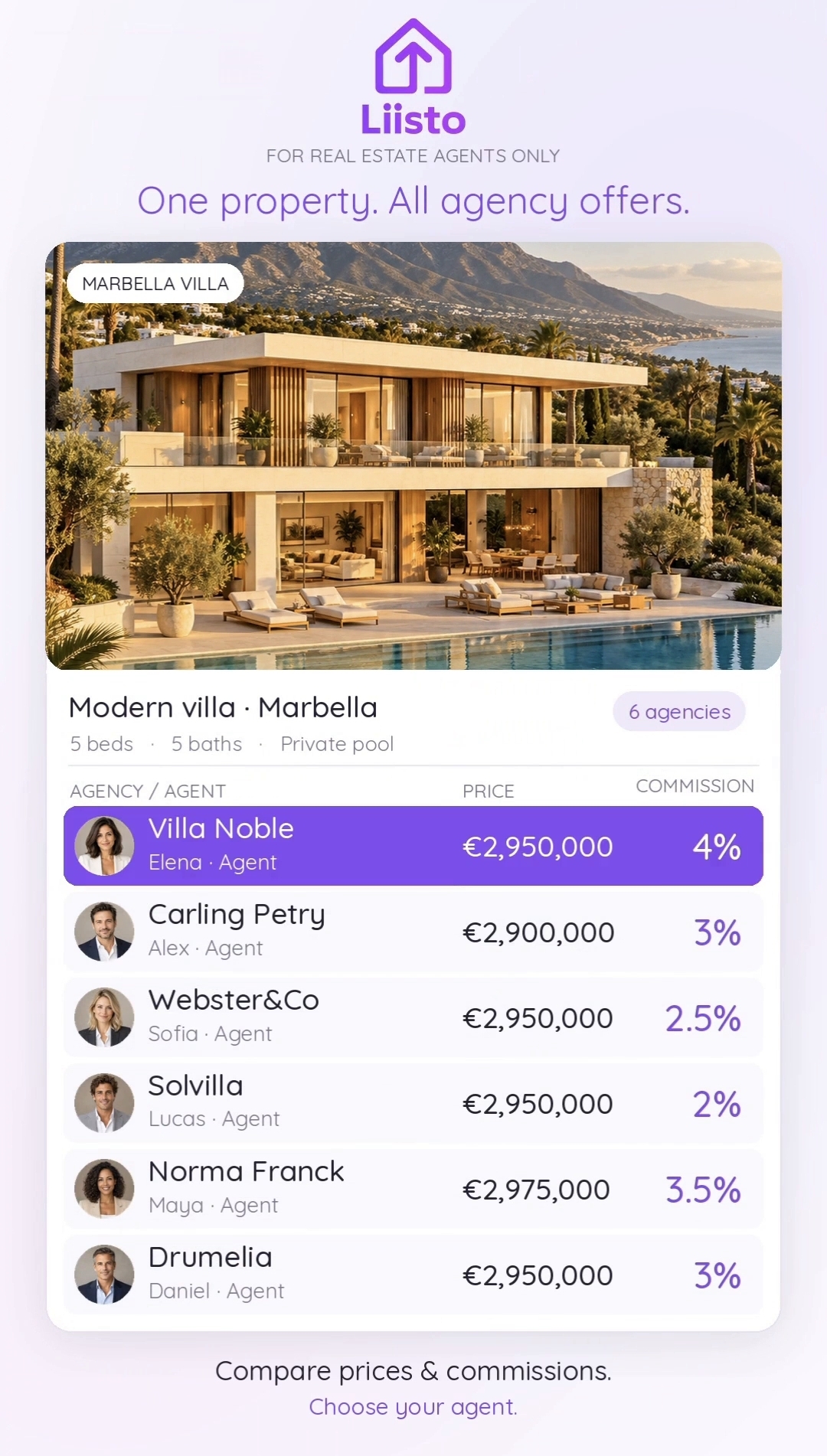
Liisto puts them together as one property with each agency’s offer, price and commission. That is much better for the client and much less confusing for us. We are comparing offers instead of duplicating work.
One property, all agency offers
How does a viewing get arranged now?
From the matched property, in a few taps: date, time, a note. The listing agent accepts it and both sides get told, and it lands in the calendar with a reminder. Open houses are in the same place with RSVP, so we do not miss the ones that are relevant to our clients.
What has actually changed for the team?
Less time inside group chats and more time with clients. The matching happens without us. The time we used to spend scrolling now goes into relationships, viewings and the transactions that come out of them.
What would you say to another agency owner in Marbella?
Your inventory and your client requests are your business. Keeping them in a chat that scrolls is a decision you can stop making. We stopped, and the matching does the part we were doing badly.
“We used to spend hours searching through chaotic WhatsApp groups. Now Liisto does the matching for us.”
A client search request, and the listings it matches
The client search request that starts every match

One client search request, every matching property in the network

The part that matters
Two directions, not one
This is the difference between a listings board and a matching engine. Liisto runs the comparison in both directions, and each direction covers two sources: the agency’s own listings or clients, and the rest of the network.
An agent uploads a client search request
Liisto checks that request against the listings belonging to the agent’s own agency and the listings published by other agents across the network, then shows the compatible ones with a score and the reasons behind it.
An agent publishes a property listing
Liisto identifies the client search requests that fit that listing: the requests inside the agent’s own agency and the requests posted by other agents on the network. The agents holding a matching client are the ones who hear about the property.
Both directions are needed. Finding a property for a client request is the obvious one; finding the agents who already have a client for a new listing is the one that surfaces demand that was never visible in a group chat. It is not simply “connecting buyers with properties”, the comparison runs from either side, and across agencies.
From a match to a viewing request
The viewing request that follows a match

The difference
What changes day to day
- Less time scrolling for something that was posted days ago.
- More time with clients, in viewings and in the deals that follow.
- Client requests posted while the details are still fresh.
- Matches arriving on their own, including properties from other agencies.
- Viewings requested and confirmed in the platform, not negotiated across four chats.
- Open houses and appointments in one calendar instead of in three group threads.
In closing
Where this leaves the working day
The interview above is one agency’s view of a working day in Marbella. The mechanics behind it are the same for every agency on the network: client search requests and listings stay in one place, the matching runs in both directions across the agency’s own inventory and the wider Costa del Sol agent network, and every match arrives with the reasons behind it.
That is also the difference between a shared listing board and an MLS for the Costa del Sol. Inventory, client search requests and agent-to-agent collaboration live in the same platform, so a property is matched against the demand that already exists instead of being broadcast into a group and lost. When the property is listed by several agencies, their offers are compared in one property view, and the viewing that follows is requested and confirmed in the same place.
The interviewee
Eduard Wittner
Founder, Villa Noble